
The Drivers of Digital Innovation: Where Will the Next Great Disruption Come From?
Digital innovation is often misunderstood. It is not simply about adopting the latest technology, buying software, or adding AI to an existing product. True digital innovation happens when technology changes the way value is created, delivered, scaled, and captured.
The companies that have transformed industries did not succeed because they had technology alone. They succeeded because they connected technology with strategy, leadership, data, talent, platforms, governance, and timing.
Look at Amazon Web Services. AWS did not merely sell cloud computing. It turned computing power into an on-demand, scalable utility for start-ups, enterprises, governments, and universities. In 2024, AWS reported net sales of $107.6 billion, growing 19% year-on-year. That is not just a technology story; it is a business model innovation story.
Look at NVIDIA. The company moved from graphics processing to becoming one of the core infrastructure providers of the AI age. Its data centre platform is now focused on accelerating AI, data analytics, scientific computing, and other compute-intensive workloads. NVIDIA shows that the next wave of innovation often comes from enabling technologies rather than from the most visible consumer-facing product.
Look at Netflix. Its innovation was not only streaming. It was the use of data, recommendation systems, content valuation, user insights, and streaming optimisation to reshape entertainment. Netflix’s own research function is embedded across business, engineering, and product teams rather than sitting apart as a distant innovation lab.
Look at Apple’s App Store. Apple did not simply create a digital shop. It created an ecosystem where developers, consumers, payments, devices, design standards, and distribution all reinforced one another. In 2024, Apple’s App Store ecosystem facilitated nearly $1.3 trillion in billings and sales worldwide. That is the power of platform innovation.
And now look at the companies trying to define the next phase. Salesforce’s Agentforce is betting on enterprise AI agents that can work across customer, supplier, employee, and data systems. Google DeepMind’s AlphaFold 3 is pushing AI into biology by predicting the structures and interactions of proteins, DNA, RNA, ligands, and other molecules. Waymo is showing that autonomous mobility is moving from experiment to operating service, reporting more than 14 million public trips in 2025.
The lesson is clear: disruption rarely comes from technology in isolation.
It comes from the interaction of eight forces:
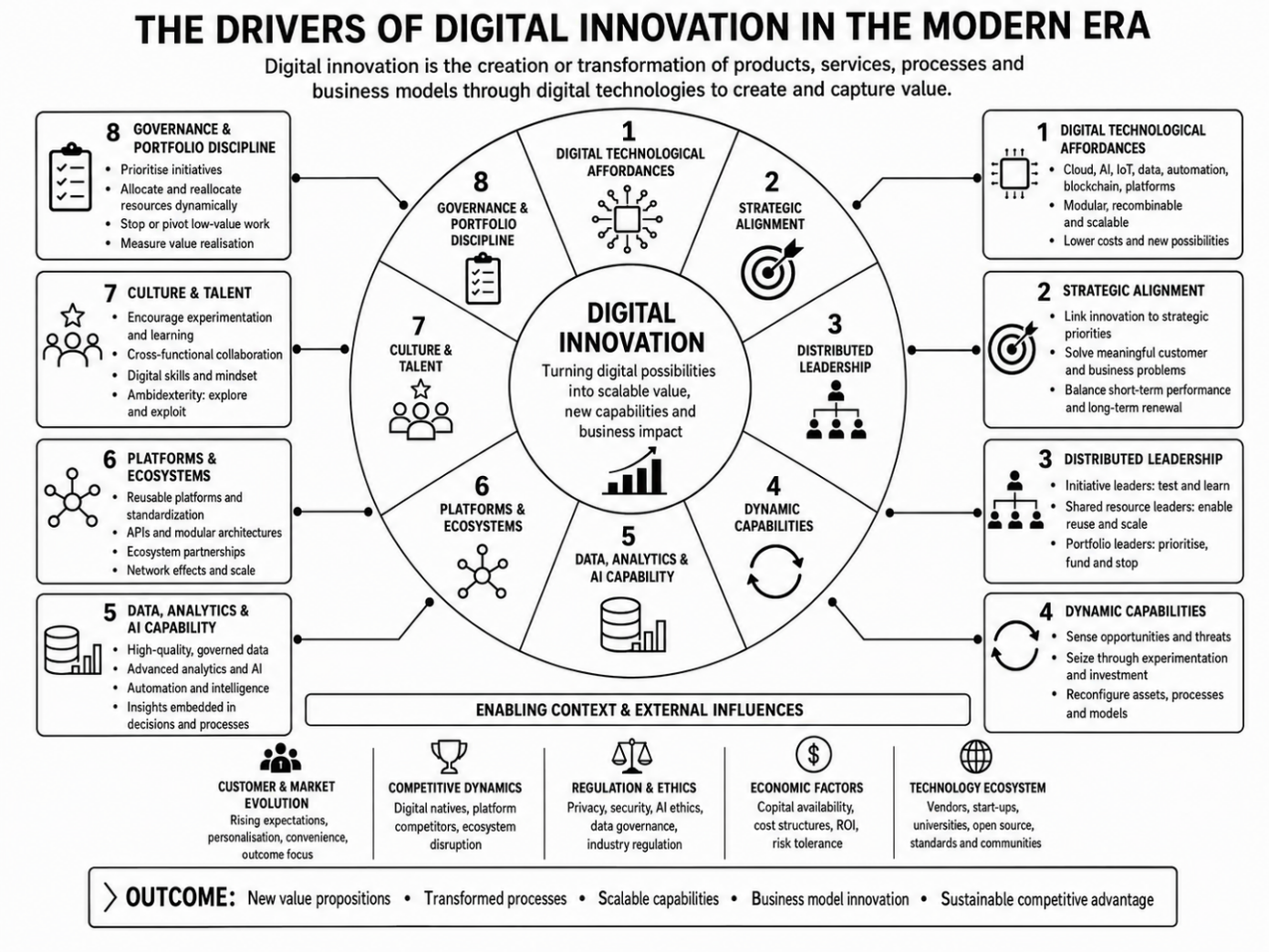
1. Digital technological affordances
Cloud, AI, IoT, automation, blockchain, robotics, and platforms create new possibilities. But possibility is not innovation until it becomes useful.
2. Strategic alignment
The best innovators link digital projects to real strategic priorities. They do not innovate for theatre. They innovate to solve meaningful customer, operational, or market problems.3. Distributed leadership
Innovation cannot sit only with the CEO or IT department. It needs leaders across the organisation who can experiment, learn, scale, and stop projects when needed.
4. Dynamic capabilities
Great companies sense change early, seize opportunity quickly, and reconfigure their assets before competitors do.
5. Data, analytics, and AI capability
Data becomes powerful only when it improves decisions, personalisation, automation, prediction, and customer experience.
6. Platforms and ecosystems
The strongest digital businesses often become ecosystems. They allow others to build, trade, connect, and create value on top of their infrastructure.
7. Culture and talent
Digital innovation needs curiosity, experimentation, cross-functional collaboration, and people who can work across technology and business.
8. Governance and portfolio discipline
Not every innovation should be funded forever. Successful organisations know when to prioritise, scale, pivot, or stop.
Where is the next major disruptive innovation coming from?
Where is the next major disruptive innovation coming from?
Will it come from AI agents that transform how organisations operate?
Will it come from autonomous vehicles and robotics, where software begins to act in the physical world?
Will it come from AI-driven healthcare and drug discovery, where biology becomes programmable?
Will it come from education, where AI tutors, digital twins, and personalised learning platforms reshape access to knowledge?
Or will it come from somewhere less obvious: a start-up, a university lab, a hospital, a school, a sports organisation, or a public-sector innovator that combines technology with a deep unsolved human problem?
My own view is this: the next great disruption will not come from the company with the most advanced technology alone. It will come from the organisation that best combines technology with trust, timing, talent, and a clear understanding of human need.
That is where digital innovation becomes more than progress.
That is where it becomes transformation.
Where do you think the next major disruptive innovation will come from?
#DigitalInnovation #AI #Strategy
#Leadership #BusinessTransformation
#Innovation #Technology
#FutureOfWork #DigitalTransformation
#Disruption