
Manchester City, the Premier League and the Long Shadow of Unresolved Justice
Manchester City’s continuing presence at the top end of the Premier League has created one of the most uncomfortable governance dilemmas in modern English football. The club remains a sporting powerhouse, capable of shaping the title race deep into the final weeks of the season. Yet, hovering above the football itself is a legal and regulatory process that has become almost as significant as anything happening on the pitch.
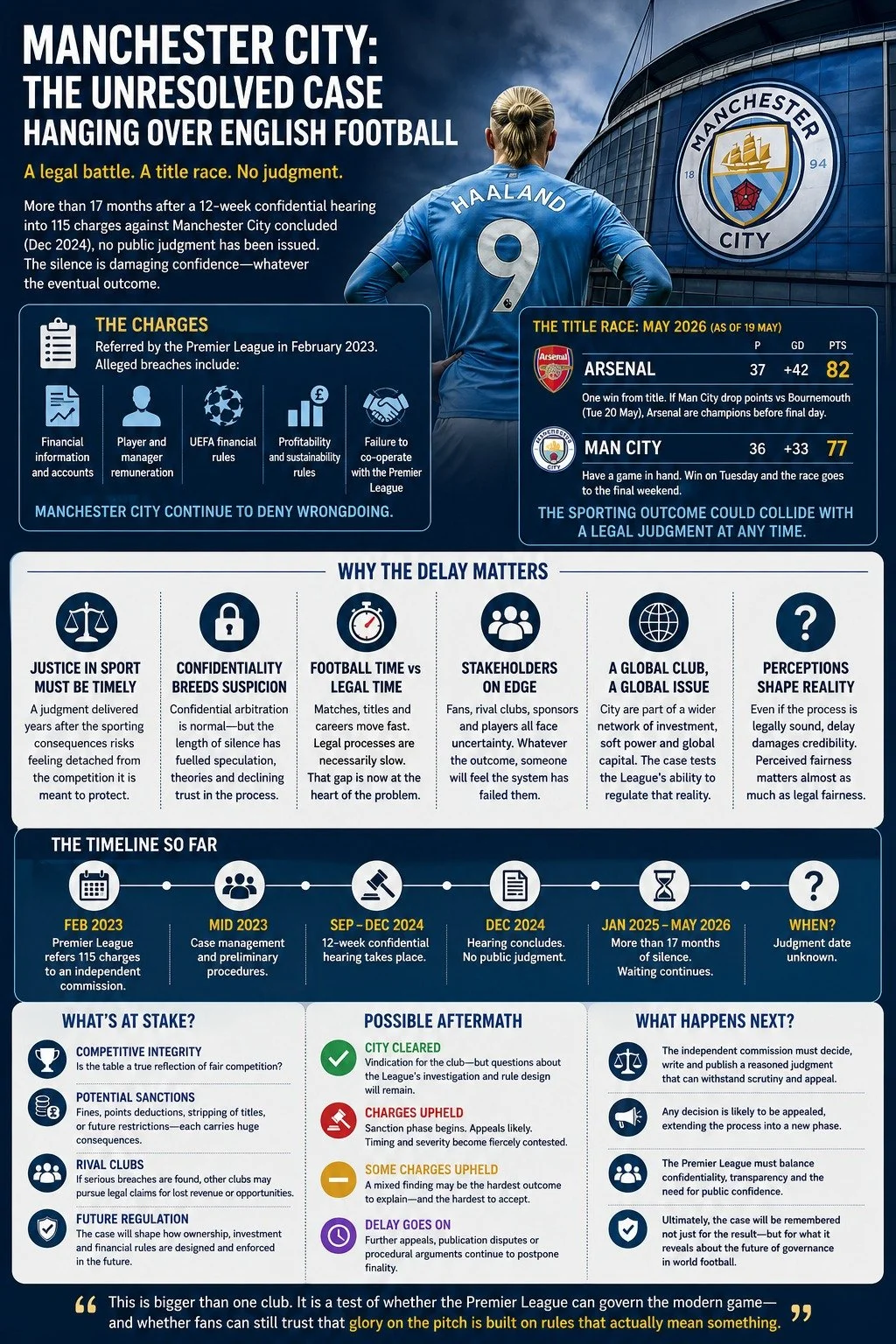
Why the Manchester City Charges Matter Beyond Football
The Premier League’s case against Manchester City, originally framed around 115 alleged breaches of league rules, has now become more than a dispute about accounting, sponsorship valuations, managerial payments, player remuneration, profitability rules or cooperation with investigators. It has become a test of whether English football can regulate its most powerful institutions with credibility, independence and timeliness. City continue to deny wrongdoing, and that denial must be taken seriously. But the sheer length of the process has allowed uncertainty to become part of the competition’s atmosphere. What began as a disciplinary matter has gradually turned into a wider question about confidence in football governance itself.
The original narrative captured this tension well, particularly the possibility that City could compete for, or even win, a Premier League title while still awaiting judgment in the charges brought against them. That possibility remains deeply awkward. A football league depends on the basic assumption that the table is meaningful: that points won, titles awarded and relegations suffered represent the outcome of fair competition. When one of the most successful clubs in the competition is simultaneously facing unresolved allegations about the financial foundations of its success, that assumption becomes harder to sustain.
This is not to say that Manchester City are guilty. Nor is it to suggest that the Premier League’s process is corrupt or deliberately evasive. The more interesting and more serious point is that justice in sport must not only be independent; it must also be sufficiently visible and timely to command trust. A judgment delivered years after the relevant sporting consequences have unfolded may still be legally sound, but it risks feeling detached from the competition it is supposed to protect.
The difficulty for the Premier League is that football time and legal time move at entirely different speeds. Football is immediate, emotional and public. A missed penalty, a late winner or a title-clinching result is absorbed instantly by millions of supporters. Legal processes, by contrast, are slow, procedural, confidential and often deliberately cautious. That gap is now at the heart of the Manchester City case. The sport demands clarity, while the legal process demands precision. The problem is that, in this instance, precision has come at the cost of public confidence.
There are understandable reasons why the case may have taken so long. The allegations cover several years and involve complex financial arrangements. The evidence is likely to be vast. The independent commission will need to address not merely whether particular rules were breached, but how the rules applied at the time, what the club knew, what the Premier League can prove, and what standard of evidence is required for each allegation. This is not a simple disciplinary case involving one transfer, one contract or one set of accounts. It is a sprawling historical inquiry into the operating model of the most successful English club of the last decade.
The commission will also know that its decision will be scrutinised with extraordinary intensity. Whatever it decides, one side is likely to be dissatisfied. If City are cleared, many rival supporters and clubs will suspect that the regulatory system has failed. If City are found guilty, the club will almost certainly challenge the decision as far as the rules allow. If only some charges are upheld, the argument will shift immediately to whether the findings are serious enough to justify a meaningful sanction. In that sense, the judgment is not the end of the matter. It is more likely to be the beginning of a new phase.
This helps explain why the panel may be proceeding with unusual caution. A rushed decision would be disastrous. But so too is a delayed decision that arrives after the sporting landscape has already changed. That is the uncomfortable paradox. The more careful the process becomes, the more it risks appearing ineffective. The longer the silence continues, the more space is created for speculation, suspicion and fatigue.The confidentiality of the proceedings intensifies this problem. Confidentiality is normal in arbitration, and there are sound reasons for it. Commercially sensitive information, contractual details, internal communications and financial records may all be involved. Yet football is not an ordinary private commercial dispute. The Premier League is a public sporting competition with global reach. Its legitimacy depends on supporters believing that the rules are applied fairly. When such a consequential case is conducted behind closed doors for such a long period, the absence of information begins to feel like an absence of accountability, even if the process itself is legally proper.
There is also a broader political economy at work. Manchester City are not merely a football club; they are part of a wider global network of investment, soft power, sponsorship, urban branding and state-linked capital. This does not mean the case is being influenced by government or geopolitical pressure. There is no evidence for that. But it does mean the stakes are unusually high. A finding against City would not simply affect a football club. It would raise uncomfortable questions about the Premier League’s embrace of global capital, the adequacy of its ownership and financial rules, and the extent to which English football has been transformed by money that traditional sporting governance was never fully designed to regulate.
In this respect, the case is not just about Manchester City. It is about the Premier League’s model. For more than two decades, the League has marketed itself as the most exciting, most competitive and most commercially successful domestic football competition in the world. That success has depended on international broadcasting, foreign ownership, high levels of private investment and a global fan base. Yet the same forces that made the League rich have also made it harder to govern. Clubs are no longer just clubs. They are investment vehicles, diplomatic symbols, media assets and components of multinational sporting groups.
The City case therefore asks whether the Premier League can regulate the very forces it has helped unleash. This is why the delay matters so much. If the League ultimately succeeds, it may claim that the process demonstrates independence and seriousness. If it fails, critics will argue that the rules were either badly designed, badly enforced or simply incapable of constraining the most powerful actors in the game. Either way, the case will shape how future regulation is understood.
The comparison with other clubs also lingers. Everton and Nottingham Forest faced penalties under financial rules on much shorter timescales. Those cases were far less complex, so the comparison is not legally straightforward. Still, from the perspective of supporters, the optics are difficult. Smaller or less powerful clubs appear to be punished quickly, while the most significant case in Premier League history remains unresolved. That perception may be unfair, but it is politically potent. In sport, perceived fairness matters almost as much as legal fairness.
The possible sanctions, if any charges are upheld, only add to the uncertainty. A fine may be seen as inadequate if serious breaches are proven. A points deduction would immediately raise questions about timing: should it apply to the current season, a future season, or retrospectively? Stripping titles would be the most dramatic outcome, but also the most legally and culturally explosive. It would rewrite history without truly repairing it. Supporters of rival clubs might feel vindicated, but the matches would not be replayed, the moments would not be relived, and the emotional reality of those seasons would remain complicated.
This is one of the distinctive problems of sporting justice. Unlike ordinary commercial disputes, football cannot easily be put back into its original position. If a company suffers financial loss, damages may compensate it. But if a club loses a title race, misses out on Champions League qualification or is relegated in a season later found to have been distorted, there is no clean remedy. Sporting time is irreversible. That is why regulatory delay is not a neutral matter. It changes the meaning of any eventual punishment.
There is also the question of rival clubs. If City are found guilty of serious breaches, other clubs may explore legal claims of their own. They may argue that they lost prize money, qualification opportunities, sponsorship value or sporting prestige because of an uneven playing field. Whether such claims would succeed is another matter, but the possibility illustrates how far the consequences could spread. The Premier League may be dealing not merely with one disciplinary judgment, but with the potential opening of a much wider litigation landscape.
At the same time, the possibility of City being cleared should not be ignored. If the club successfully defeats the charges, the consequences will be profound in a different way. City would present the outcome as vindication after years of suspicion. The Premier League would face questions about the strength of its investigation and the wisdom of bringing such an enormous case if it could not prove the allegations. Supporters who have already formed strong views would not necessarily be persuaded, but legally the club would be entitled to claim that the process had confirmed its position.
That is why the eventual judgment, whenever it comes, will need to do more than announce a result. It will need to explain itself. A bare outcome will not be enough. The football world will want to know what was proven, what was not proven, why particular evidence mattered, how the rules were interpreted, and what the decision says about the League’s regulatory authority. If confidentiality leads to excessive redaction, the judgment may fail to settle the debate even when it formally concludes the case.
The Premier League is therefore trapped between legal caution and public expectation. Publish too little, and the process looks opaque. Publish too much, and commercial confidentiality or appeal rights may become contested. Move too quickly, and the decision may be vulnerable. Move too slowly, and the competition’s credibility suffers. There is no easy path now because the delay itself has become part of the damage.
The most likely explanation remains the least dramatic one: the case is huge, the evidence is complex, the panel is being careful, and the final decision is difficult to draft. That explanation may be true. It may also be insufficient. Institutions are judged not only by whether they eventually arrive at the right answer, but by whether they maintain legitimacy while getting there. On that measure, the Premier League is under real pressure.
For Manchester City, the continued uncertainty is damaging too. Even if the club is eventually cleared, years of unresolved allegations have shaped public perception of its achievements. Every title challenge takes place in the shadow of the case. Every success is accompanied by an asterisk in the minds of critics. That is not a healthy position for the club, the League or the sport. City have an interest in finality just as much as the Premier League does.
For Arsenal and other rivals, the situation is equally unsatisfactory. If they win, they do so in a league still carrying unresolved questions about its recent past. If they lose to City, the question of competitive integrity becomes even louder. Either way, the title race is no longer simply a sporting contest. It has become entangled with regulatory uncertainty.
The deeper issue is that English football is now confronting the consequences of its own success. The Premier League became a global commercial machine before it became a fully mature regulatory institution. Its wealth attracted owners, sponsors and strategic investors from across the world. But the mechanisms designed to police that wealth have often appeared reactive, fragmented and slow. The Manchester City case may therefore be remembered not only for its outcome, but for what it revealed about the limits of self-regulation in elite football.
In the end, this is why the case matters so much. It is not simply about whether one club broke rules. It is about whether rules still have authority in a competition dominated by immense wealth, global ownership and legal sophistication. It is about whether sporting merit can be protected in an environment where financial engineering may be as important as coaching, recruitment or youth development. It is about whether fans can trust that what they see on the pitch has not been distorted off it.
Until the judgment is delivered, English football remains in a state of suspended animation. The matches continue, the trophies are contested, the crowds roar and the television audiences grow. But beneath the spectacle lies an unresolved question that the Premier League cannot avoid forever: can the most commercially successful league in the world still govern itself with the clarity, courage and credibility that sporting integrity requires?
That is the real significance of the Manchester City case. Not the intrigue of what may or may not be happening behind closed doors. Not even the precise number of charges eventually upheld or dismissed. The real issue is whether English football can still persuade the public that its rules are meaningful, its processes are independent, and its champions are beyond serious doubt.